

The sand die casting process is a foundational and highly versatile manufacturing method where molten metal is poured into a disposable mold made from engineered sand. For design and manufacturing engineers, the strategic advantage of the sand die casting process lies not in its simplicity, but in its unique combination of geometric freedom, broad material compatibility, and cost-effectiveness for low to medium production volumes. This sand casting procedure is distinct from high-pressure die casting, offering unparalleled flexibility for producing large, complex components in virtually any alloy… Understanding the fundamentals of the sand die casting process is key to leveraging its full potential for prototypes and end-use sand casting products.
This guide will dissect the sand die casting process through an engineer’s lens. We will move beyond a basic description of what is sand casting to explore the critical design parameters, material science, and quality considerations embedded within each step of the sand casting process. Our goal is to provide a clear sand casting procedure framework that empowers better design decisions, effective supplier communication, and optimal outcomes for your sand cast metal components.
Pattern Making

Molding
Mold Closing

Pouring

Cooling and Demolding

Post-Processing

Step 1: Pattern & Core Box Engineering
The sand die casting process begins with tooling design. A pattern, which is a positive replica of the final part, is used to form the cavity in the sand mold. For engineers, the pattern is not an exact copy; it must incorporate critical allowances:
Shrinkage Allowance: The pattern is oversized according to a precise percentage specific to the metal alloy being used (e.g., ~1.3% for aluminum, ~1.0% for gray iron) to account for solidification contraction.
Draft Angle: All surfaces perpendicular to the parting line require a minimum draft (typically 1°-3°) to ensure clean pattern withdrawal from the compacted sand casting mould without damage.
Machining Allowance: Additional material is added to surfaces that will be machined post-casting.
Core Prints: These are extensions on the pattern that form registration seats in the sand molds to accurately locate and support internal sand cores, which create complex internal passages.
Engineer’s Insight: The choice of pattern material (wood, plastic, metal, or 3D-printed composite) is a direct trade-off between durability for long runs, dimensional stability for precision sand castings, and initial cost. For complex parts of sand casting or rapid prototyping, patterns for sand casting can be 3D-printed directly from a CAD model, accelerating the initiation of the sand moulding process.
Step 2: Mould & Core Making: The Science of the Sand Mold
This phase creates the negative cavity that defines the part’s geometry. The “sand” in the sand die casting process is a sophisticated, engineered composite material. The sand casting mold making stage involves:
Moulding Sand Preparation: Base silica sand is blended with a binder and other additives. The binder system defines the sand moulding procedure type:
Green Sand: Uses moist clay (bentonite) as a binder. It is the most common and cost-effective method for the sand casting of metals, offering good reusability but relatively lower dimensional accuracy.
Chemically-Bonded Sand: Uses resins (e.g., furan, phenolic) or inorganic binders (e.g., sodium silicate). This sand molding method produces stronger, more rigid sand molds capable of capturing finer detail and holding tighter tolerances, making it ideal for critical sand castings and complex cores.
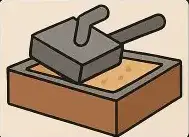
Mould & Core Formation: The prepared sand is compacted around the pattern within a metal frame (flask). For hollow sections, separate sand cores are manufactured in core boxes and later positioned in the mould cavity. The proper sand casting mould making technique is crucial to the integrity of the final sand cast.
Step 3: Melting, Pouring & Solidification Control
This is where metallurgy and fluid dynamics take center stage in the sand die casting process.
Melting & Treatment: Alloy is melted in a controlled furnace (induction, crucible). Critical treatments like degassing (to remove hydrogen) and slag removal are performed to minimize porosity and inclusions in the sand cast metal.
The Pouring Event: Pouring is a controlled scientific operation, not merely a transfer. Key parameters are:
Pouring Temperature: Typically maintained 100°C – 150°C above the alloy’s liquidus temperature to ensure proper fluidity.
Pouring Rate: Must be optimized to fill the mould quickly enough to avoid a “cold shut” (incomplete fusion), but calmly enough to prevent turbulent flow, which erodes the sand mould and traps gases.
Gating System Design: This engineered network of channels (pouring cup, sprue, runners, and gates) is a critical part of the sand casting process. Its design ensures molten metal flows smoothly into the cavity, minimizes turbulence, and facilitates proper feeding during solidification.
Step 4: Cooling, Shakeout & Deflashing
After pouring, the sand cast component must solidify under controlled conditions. Cooling time is dictated by the part’s thermal mass and section thickness.
Shakeout: Once solidified, the mould is moved to a shakeout station where vibration breaks the brittle sand mold away from the metal casting—a key step in the sand casting procedure.
Deflashing/Initial Cleaning: The raw sand casting is then cleaned to remove the remaining sand, the gating system (runners, risers), and any flash (thin metal at the mould parting line), typically via cutting, grinding, or shot blasting.
Step 5: Finishing, Inspection & Sand Casting Machining
The final steps ensure the part meets all specifications.
Finishing Operations: This may include sand casting machining on critical surfaces to achieve precise dimensions or specific surface finishes. Heat treatment (e.g., annealing, quenching & tempering) is often performed to achieve required mechanical properties in the sand cast metal.
Quality Inspection & Validation: The completed sand casting products undergo rigorous checks, which may include:
Dimensional Inspection: Using CMMs, calipers, or laser scanners.
Non-Destructive Testing (NDT): Such as dye penetrant inspection for surface defects or X-ray for internal integrity.
Material Certification: Verification of chemical composition and mechanical properties.
Engineering Optimization in the Sand Die Casting Process
Design for Manufacturability (DFM) Principles
To minimize cost and defects in the sand die casting process, engineers should adhere to core DFM principles:
Maintain Uniform Wall Thickness: Promotes even cooling and reduces shrinkage defects.
Use Generous Fillets and Radii: Sharp corners create stress concentrations and are prone to hot tearing.
Design for Efficient Core Usage: Simplify internal geometries where possible to avoid complex, fragile sand cores.
Specify Realistic Tolerances: Standard linear tolerances for the sand die casting process are typically ±0.010″ for the first inch. Tighter tolerances require more expensive tooling and processes.
Comparative Process Selection
The sand die casting process is one of several metal casting options. Its primary advantages are low tooling cost, exceptional size capability, and material versatility. It is often the default choice for large parts, low-to-medium volumes, and alloys unsuitable for high-pressure die casting. For high-volume production of small, precise parts in non-ferrous alloys, high-pressure die casting may be more economical despite its higher initial tooling cost.
Root Cause Analysis of Common Defects
Understanding defects is essential for process control and design feedback in the sand casting of metals:
Porosity: Often caused by gas entrapment (poor degassing, wet sand) or shrinkage (inadequate feeding from risers).
Sand Inclusions: Result from mould erosion due to turbulent metal flow or a low-strength sand mould.
Dimensional Variation: Can stem from inconsistent sand compaction, pattern wear, or mould wall movement.
Mastering the Sand Die Casting Process for Project Success
In summary, the sand die casting process remains an indispensable and strategic tool for engineers. Its core strength is enabling the production of complex, durable metal components with minimal investment in hard tooling. Success with this sand moulding process hinges on early collaboration between the design engineer and the foundry. Engaging in a formal design review before finalizing drawings can proactively address issues related to draft, wall thickness, feeding, and sand casting machining, ultimately saving time and cost.
By mastering the principles outlined—from the material science of what is casting sand to the physics of solidification—engineers can effectively specify and leverage the sand die casting process to create robust, cost-effective components that are vital across industries like heavy equipment, energy, aerospace, and automotive manufacturing. A deep understanding of how to sand casting and its variables transforms it from a simple craft into a predictable and powerful engineering solution.